We recently posted about Green Open Access and how depositing your work in Charles Sturt’s institutional repository (CRO) can make your research openly available without paying an Article Processing Charge (APC). The key to doing this is your Author Accepted Manuscript (AAM).
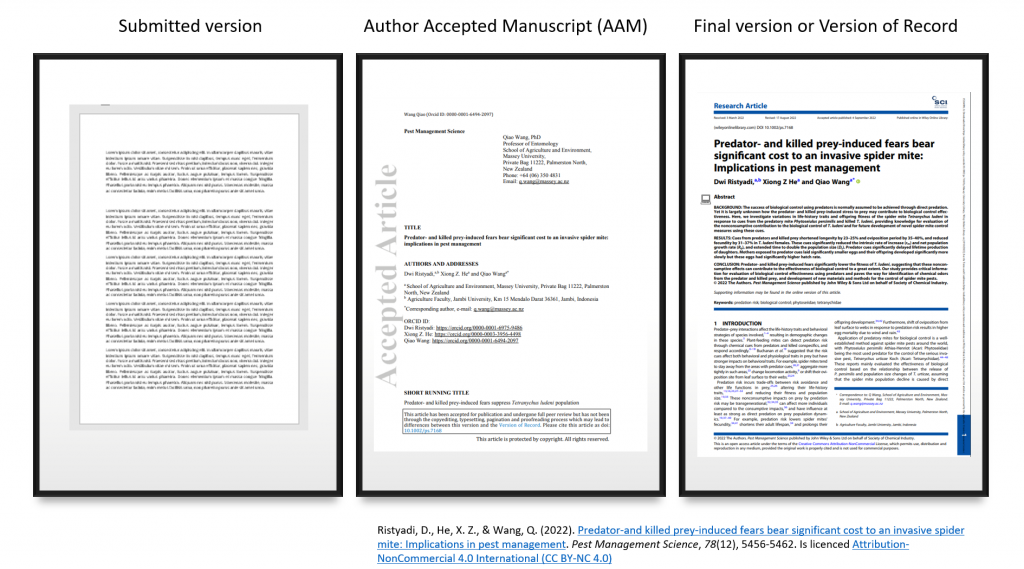
What is an Author Accepted Manuscript?
An AAM is the version of your article that has been:
- successfully peer reviewed
- revised following reviewer comments
- accepted by the journal for publication
It contains all the final scholarly content of your paper — it just hasn’t been copyedited, typeset or branded by the publisher yet. You might also see it called the accepted manuscript or postprint.
Why does it matter?
For many publishers, the AAM is the version you’re permitted to deposit in a repository like CRO, meaning you can often make your research openly available without paying an APC
Depositing and making your AAM open access can:
- increase the visibility and reach of your research
- help your work be discovered, read and cited
- support compliance with funder and institutional Open Access requirements
- make older publications accessible, even if they were originally published behind a paywall
In many cases, your AAM is the key to unlocking Open Access for your research.
Where can I find my AAM?
Good news – most researchers find that they already have one sitting somewhere. Common hiding places include:
- email attachments from when the journal accepted your manuscript
- the folder where you saved it during the publication process
- your OneDrive, Dropbox or other cloud storage
- your research group’s shared folders
- a co-author’s files (especially if you weren’t the lead or corresponding author)
If it’s a Word document, that’s perfectly fine. It doesn’t need to be the publisher’s polished PDF.
What if I can’t find it?
Older publications can take a bit of detective work. Check email archives, old project folders, and ask co-authors if they still have a copy.
If you genuinely can’t locate it, don’t let that put you off – recovering some of your manuscripts is better than none, and each one you do find is another publication that could be made openly available through CRO.
It’s also a good reason to build the habit now! Save your AAM the moment your next paper is accepted, and future-you won’t need to go looking at all.
Ready to see what you’ve got? Register your interest in Bring Out Your Dead by emailing libresearch@csu.edu.au
Discover more from Charles Sturt University Library Blog
Subscribe to get the latest posts sent to your email.