This year’s National Reconciliation Week theme, All In, invites all of us to reflect on how we take responsibility for reconciliation in our everyday actions.
National Reconciliation Week (NRW), held each year from 27 May to 3 June, is a time for learning, reflection and action. The theme All In reminds us that reconciliation is not symbolic or passive. It is shaped by the choices we make in our study, work and use of shared spaces, including how we seek information, how knowledge is represented and how we engage with First Nations peoples, histories and knowledges with care and respect.
In a Library context, this responsibility is closely tied to our role as information and record‑keeping institutions. Many libraries and archives have been built on Euro‑centric information and recordkeeping practices that were developed without First Nations authority or consent, which has shaped how First Nations peoples, histories and knowledges have been collected, described and represented within institutional systems. Understanding this context is an important foundation for strengthening contemporary approaches to cultural safety and responsible information practice.
Responding to this history is ongoing and shared work. The Library continues to strengthen cultural safety across its resources, spaces, services, systems and collections. Everyone who uses the Library can also play a part through everyday actions, such as how information is accessed, interpreted, described and shared.
This NRW, we’re highlighting three practical ways to engage with reconciliation through the Library. Each offers an entry point for going All In with care to support respectful learning, reduce harm and uphold Indigenous authority during NRW and beyond.
First Nations Excellence in Research Collection
The First Nations Excellence in Research Collection is an evolving body of work that recognises and celebrates the depth, diversity and impact of First Nations research at Charles Sturt University.
The collection brings together:
- research authored by First Nations researchers, and
- research developed in genuine, clearly acknowledged collaboration with First Nations peoples.
As new outputs are added to Charles Sturt Research Output repository (CRO), this collection continues to grow, strengthening the visibility of First Nations research within and beyond the University.
With the academic promotion period underway, adding your work to this collection is a simple way to highlight First Nations research excellence, while ensuring your publications are accurately represented across Charles Sturt’s broader research profile.
The CRO Library guide outlines the inclusion criteria and step‑by‑step guidance for adding your research to this collection. Inclusion in the collection relies on authors and contributors exercising care, judgement and responsibility. Entries may be reviewed if questions arise regarding authorship, collaboration, cultural authority or attribution.
Regional Archive Collections
Taking action also means taking the time to listen, learn and reflect. The Charles Sturt University Regional Archives (located on Level 4 of the Wagga Wagga Campus Library) is a welcoming and engaging space for students, staff and community members to do just that.
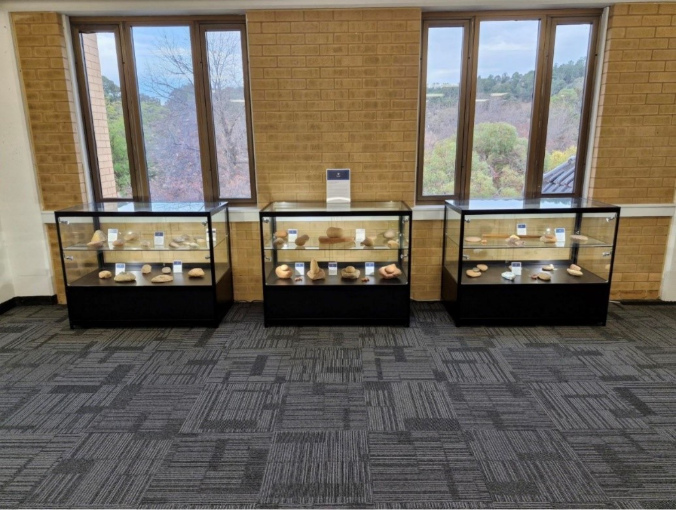
During NRW, consider taking a moment to visit the Regional Archives. As you spend time in the space, be sure to look for two cultural collections on display: the Lashbrook Stones Collection and the Wiradyuri Language Collection.
The Lashbrook Stones display features various types of First Nations stone tools and cultural objects, including milling grinding stones, multipurpose stones (which combine hammer and grinding functions), fire stones, stone axes and nardoo stones.
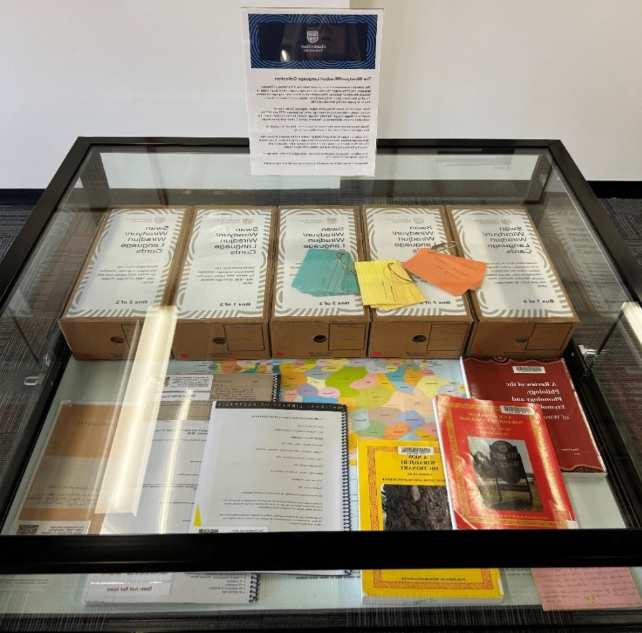
The Swan Wiradyuri Language Collection is another display, which includes the Swan Wiradyuri Language cards of approximately 4000 Wiradyuri words, Wiradyuri language resources, and an AIATSIS Indigenous Languages Map of Australia.
Materials in the Wiradyuri Language Collection were shared with the Library and are displayed with advice from a Wiradyuri community member, Uncle Lloyd Dolan, based at the Wagga Wagga campus, who also generously donated a title for inclusion.
These collections are held with care, and visitors are encouraged to engage with them respectfully, recognising their cultural significance and ongoing connection to Country. Visiting these collections is a meaningful way to pause and reflect, as we continue to work together to support a culturally responsive learning community.
Reparative descriptive practices
In 2022, the Charles Sturt University library launched a cultural safety project to improve First Nations students’ experiences. A key outcome was introducing reparative description practices to identify, update and contextualise outdated or harmful language in our collection records.
“Reparative description addresses bias and harmful or offensive language that exists in legacy descriptions.”
National Library of Australia, 2024.
To support respectful representation and truth-telling, we have added cultural warnings across our homepage and catalogue, introduced a “Right of Reply” option in Primo Search, and updated standard metadata practices for all new and existing records.
Key catalogue updates include:
- Reducing harm caused by offensive call number suffixes used in legacy cataloguing practices, including replacing outdated abbreviations with more respectful terminology. However, retaining existing descriptive fields to support truth-telling.
- Enhancing MARC metadata by adding AustLang codes (041 field), AIATSIS subject headings (650 field), AIATSIS place names (651 field), and where appropriate, exploring the use of the 545 field for Country and ancestry information, and the 700 field for recording storytellers or other contributors.
- Acknowledging intellectual property by clearly labelling AIATSIS headings as “First Nations (AIATSIS)” in the discovery layer.
These practices are now standard for new acquisitions, with work ongoing to update all existing records. This work continues to evolve through consultation with First Nations staff and students, and through feedback from users of the collection, and is guided by community priorities and sector leadership, including the ALIA Reparative Description Community of Practice.
How Will You Go ‘All In’?
Reconciliation is a shared journey that requires everyday actions from all of us. Whether you are adding your research, taking time to learn through the Regional Archives, or reflecting on how your work is informed by, and responds respectfully to First Nations perspectives. Your participation matters.
How will you go All In?
References
Aboriginal and Torres Strait Islander Library, Information and Resource Network. (2012). The Protocols. https://atsilirn.aiatsis.gov.au/protocols.php
ALIA Community on Resource Description. (2026). Reparative Description Community of Practice. https://acord.alia.org.au/communities-of-practice/rdcop/
Hall, Y., & Hill, M. (2025). Cultural safety in the Charles Sturt University Library. In Kummargii Yulendji Symposium Proceedings 2024. Informit. https://search.informit.org/doi/10.3316/informit.T2025082100012690248492864
National Library of Australia. (2024). Collection description policy [Policy Number: PCY21/012]. https://www.library.gov.au/visit/about-us/corporate-information/collection-policies-and-plans/collection-description-policy#heading-10755
Raven, T. (2023). Guidelines for First Nations collection description. National and State Libraries Australasia. https://nla.gov.au/nla.obj-3250767341/view
Discover more from Charles Sturt University Library Blog
Subscribe to get the latest posts sent to your email.